
Game-outcome verification
FairSpin provably-fair games explained 2026
FairSpin carries provably-fair games from partner studios including BGaming and Spribe. The mechanism uses server-seed and client-seed concepts, while bet results are described as being recorded on-chain. That can make a supported game outcome more inspectable, but it does not turn every casino process into cryptographic proof.
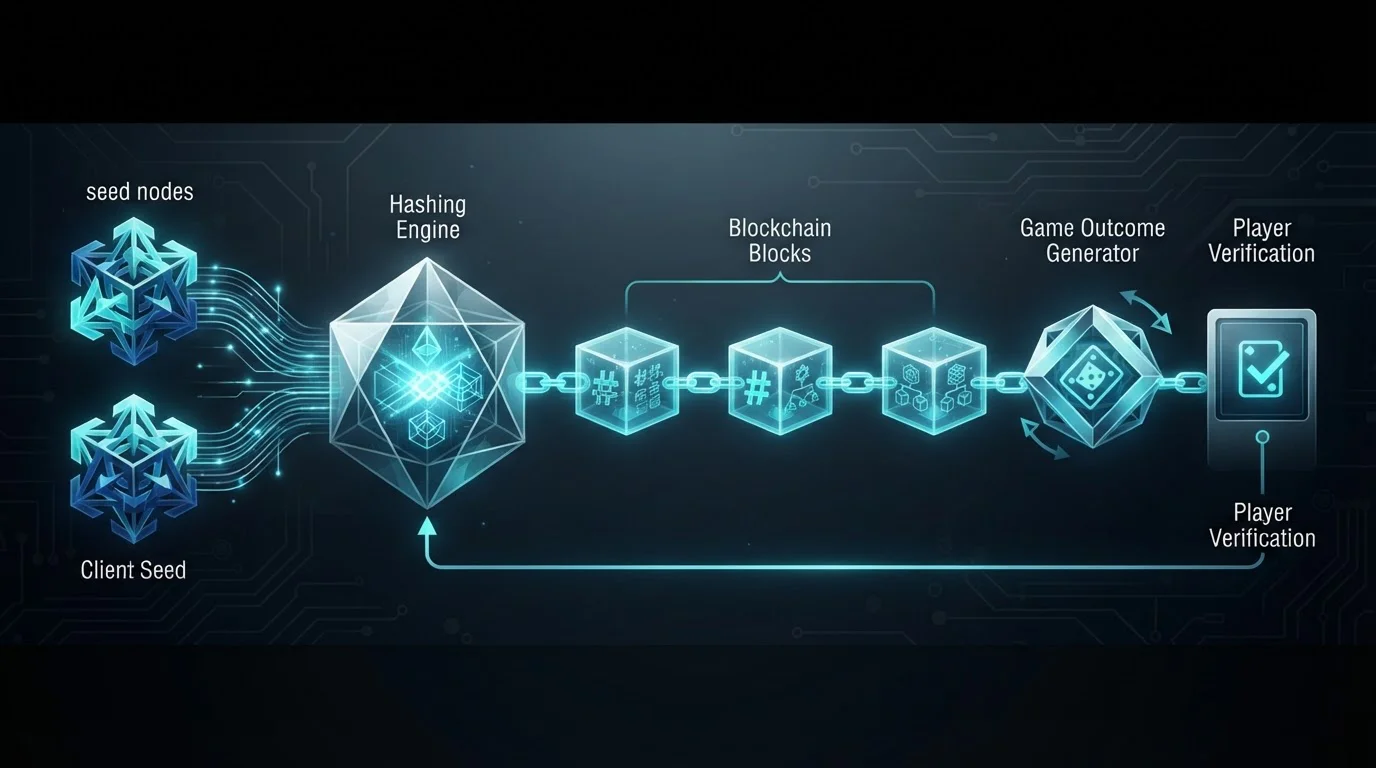
Provably fair is a specific layer inside FairSpin’s wider game catalog
FairSpin offers provably-fair games from partner studios including BGaming and Spribe. The verification feature applies to selected partner titles rather than the entire FairSpin library, so the individual game is the right unit to inspect.
- Provably-fair gamesAvailable
- Named studiosBGaming and Spribe
- Seed modelServer Seed + Client Seed
- Result recordDescribed as on-chain
No FairSpin in-house originals studio has been identified. The practical consequence is straightforward: the verifiable-game layer comes from partner content rather than a separate FairSpin-made originals catalog. When you want to verify a round, start with the individual game and studio rather than assuming there is one universal casino-wide checker.
The parent FairSpin games guide puts this feature beside live casino and conventional provider content. That context helps because “provably fair” describes how a supported result can be checked; it is not a synonym for the entire game library.
Server and client seeds create a before-and-after trail for a supported round
At a high level, a provably-fair system separates information that exists before the wager from information revealed afterward. The server side contributes a secret value, while the client side contributes another input. The game combines those inputs through its defined method to produce a result.
The useful property is commitment. A game can expose a cryptographic representation of the server-side value before the round, then reveal enough information afterward for the player to check that the committed value was not silently replaced after the outcome was known. The exact formula and interface depend on the game, so the game’s own verification controls remain essential.
Server Seed
A server-side input used by the game. In a provably-fair flow, the player should have a way to compare the later-revealed seed with the commitment made before the result.
Client Seed
A client-side input that contributes to the result-generation process. Its role is to keep the outcome from depending on a server-only value.
Verification
The checking step compares the committed and revealed information using the method supplied by the supported game. A match supports the integrity of that round’s seed trail.
The key question is narrow: can the inputs and result for this specific game round be checked using the game’s verification method? That is more precise than treating “blockchain casino” as a blanket fairness claim.
A verification walkthrough should start with the game, not the casino label
FairSpin’s partner-studio provably-fair games use server/client-seed mechanics. The checking sequence starts with the controls exposed by the individual game because interfaces and calculation steps can differ by title.
- Confirm that the exact game you are using exposes a provably-fair or seed-verification function.
- Locate the pre-round commitment or seed information shown by that game before treating the result as independently checkable.
- After the round, obtain the revealed seed/result information that the game makes available for verification.
- Use the game’s own checking method to compare the committed information with the revealed values and calculated result.
- If the game exposes an on-chain record, treat it as an additional record of the event rather than as a substitute for understanding the game formula.
| Step | What you inspect | What a successful check supports |
|---|---|---|
| Before the round | Seed commitment or equivalent pre-result reference | The game committed information before the outcome was revealed. |
| After the round | Revealed server/client data and result inputs | You have the values needed for the game’s checking method. |
| Verification | Game-specific calculation or verifier output | The checked round follows the disclosed seed relationship. |
| On-chain record | Recorded result-related data where provided | An external record exists for the event described by the game. |
A failed or confusing check is a reason to stop and understand the interface before placing more wagers. The value of provably fair comes from being able to perform the verification, not merely from seeing the phrase in a lobby description.
On-chain recording adds persistence, but the record still needs interpretation
FairSpin describes bet results as being recorded on-chain for provable transparency. A blockchain record can add persistence because recorded data is not meant to be silently rewritten like an ordinary private database entry. That is useful as an audit trail for the event the system chooses to record.
Persistence is not the same as explanation. A transaction or record can show that data was written, yet a player still needs to understand what the data represents and how it relates to the game result. If the game uses seeds and hashes, the verification logic connects those cryptographic inputs to the outcome; the blockchain record is another layer, not the whole argument.
Seed commitment
Helps establish that relevant input information existed before the result was known.
Seed reveal
Provides information needed to test the earlier commitment after the round.
Game calculation
Links the disclosed inputs to the result according to the game’s method.
On-chain record
Adds a persistent external record where the supported game uses that layer.
This is also why a public blockchain entry should not be treated as a universal trust badge. It can strengthen the audit trail for a particular event, but it does not automatically answer account, payment or customer-service questions.
A verifiable game outcome does not prove every other part of the casino experience
Provably-fair technology solves a bounded problem: it can make the generation or recording of a supported game result more inspectable. It does not prove that every operational process surrounding the game is fair, fast or frictionless.
What a successful round check can support
- The disclosed seed relationship matches the game’s verification method.
- The checked result follows the inputs exposed for that round.
- An on-chain record, where used, adds a persistent event trail.
What it does not settle by itself
- Whether a withdrawal will require additional identity checks.
- How long a payment transfer will take under current network conditions.
- Whether a bonus condition applies to a particular wager.
- Whether short-term gambling results will be favorable.
That boundary is practical, not academic. If your question is about moving crypto, use the FairSpin payments section. If your question is about streamed dealer play, use the FairSpin live casino guide. A seed check should not be stretched into evidence for unrelated systems.
BGaming and Spribe make the verifiable layer a partner-game feature
BGaming and Spribe are the named studios associated with FairSpin’s provably-fair content. That matters because the game provider can determine how the verification interface is presented and which inputs a player can inspect.
No in-house FairSpin originals studio has been identified, so there is no basis for treating the casino as the maker of a separate proprietary provably-fair catalog. The more accurate model is a broad third-party game library that includes selected partner titles with seed-based verification.
| Layer | FairSpin-specific context | Reader takeaway |
|---|---|---|
| Partner studios | BGaming and Spribe are named for provably-fair content | Look at the individual provider/title for the checking method. |
| FairSpin originals | No in-house originals studio identified | Do not assume a separate FairSpin-made originals ecosystem. |
| Blockchain layer | Results are described as recorded on-chain | Use the record as part of the audit trail, not as a substitute for game-level verification. |
FairSpin also positions itself around blockchain transparency. That positioning is most useful when reduced to a concrete reader action: identify a supported game, find its verification controls, and check a round instead of relying on the branding alone.
Verification is most useful as a repeatable habit rather than a one-time badge check
A provably-fair feature has little practical value if it is never used. You do not need to verify every wager, but checking the process before committing to a longer session shows whether you understand the interface and whether the game exposes the information you expect.
- Choose a supported game from a named partner studio rather than assuming the whole lobby uses one mechanism.
- Find the seed or fairness controls before wagering so you know where the relevant information lives.
- Run a small verification example and make sure you can follow the relationship between commitment, reveal and result.
- Keep game verification separate from bankroll decisions; a checkable outcome can still be a losing outcome.
Provably fair does not reduce gambling volatility. A result can be cryptographically checkable and still produce a loss. Use the feature to inspect process integrity, not to predict future outcomes or justify higher stakes.
The same separation applies to crypto transfers. Blockchain payments are irreversible, and crypto prices can move while funds are being transferred. Those risks exist independently of whether a game round is verifiable.
Questions readers ask about FairSpin provably fair
Does FairSpin have provably-fair games?
Yes. FairSpin offers provably-fair games from partner studios including BGaming and Spribe.
How do FairSpin provably-fair games work?
The supported games use server-seed and client-seed concepts so the relationship between committed inputs and a result can be checked through the game’s verification method.
Are FairSpin game results recorded on-chain?
FairSpin’s provably-fair game results are described as being recorded on-chain for provable transparency, adding a persistent record to the game-level verification process.
Are all FairSpin games provably fair?
No. Provably-fair mechanics apply to selected partner-studio games rather than the whole FairSpin library.
Does FairSpin have its own provably-fair originals studio?
No in-house FairSpin originals studio has been identified. The provably-fair content described here comes from partner studios such as BGaming and Spribe.
Read next
- FairSpin games and providers
- FairSpin live casino
- FairSpin review
- FairSpin payments and crypto networks
FairSpin’s verifiable layer is game-specific, not casino-wide
FairSpin’s useful provably-fair feature is concrete: selected partner games from BGaming and Spribe expose a seed-based verification model, and results are described as recorded on-chain. Treat that as a way to inspect supported rounds, not as proof of unrelated casino operations or as a prediction of future results. The strongest use of the feature is simple—find the game-level controls and verify what they actually show.
Created by the ”FairSpin” editorial team.